
For fifty years, we have tried to solve the gender pay gap by fixing the workplace. We passed laws. We built HR departments. We invented DEI programs, normalized maternity leave, subsidized childcare, and told a generation of women to lean in. Some of it helped. Real people got real careers they would not have had in 1975.
And yet the gap did not close. In the year 2000, American women earned about 80 cents on the dollar. Twenty years and a thousand initiatives later, they earn about 84.[1] That is not progress. That is a plateau wearing the costume of progress.
I want to argue something that will make almost everyone in this debate uncomfortable, on both sides: the reason we cannot close the gap with policy is that the gap was never mostly a policy problem. It is a biology problem. And the technology most likely to finally move the number is not a law, a quota, or a corporate program. It is a medical procedure.
The Trap Nobody Wants to Name
Here is the finding that should have reorganized this entire conversation and somehow didn't.
Claudia Goldin won the Nobel Prize in economics for it.[2] When you track MBA graduates from elite schools, men and women start at nearly identical pay. For years, the lines run almost on top of each other. Then, somewhere around year eight or nine, they split — and the split is not subtle. By roughly a decade out, the women who took even short career breaks or shifted to fewer hours never catch back up. The gap that opens is not opened by hiring bias or starting salaries. It opens at the exact moment children arrive.[4]
This is the motherhood penalty, and it is now the single largest driver of the gender earnings gap in high-earning careers.[4] Not discrimination in the crude sense. Something harder to fix.
Because the cruelest part is the timing. The years when elite careers compound fastest — late 20s through late 30s, when you make partner, get tenure, raise the round, build the reputation that pays for the next twenty years — are the exact same years when female fertility is at its peak and beginning its decline. Two clocks, running at once, pointed in opposite directions. You cannot pause one to attend to the other without the first one quietly charging you for the time.
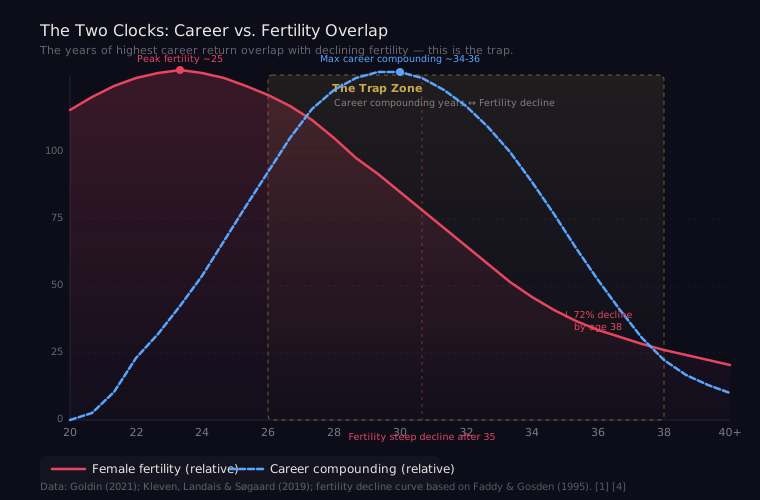
We have spent decades trying to make the career softer around motherhood. Almost nobody has asked the more radical question: what if the biological deadline itself became negotiable?
Why Pharmacy Beat Feminism
If you think the gap is really about bias, consider the profession that quietly solved it: pharmacy.
Pharmacists have a near-zero gender pay gap.[3] Not because pharmacists are more enlightened than lawyers, but because of how the job is built. In pharmacy, an hour is an hour. Two pharmacists working part-time are almost perfectly substitutable for one working full-time. The returns to hours are linear. Step away for two years, come back, and you have lost two years of salary — no more, no less.
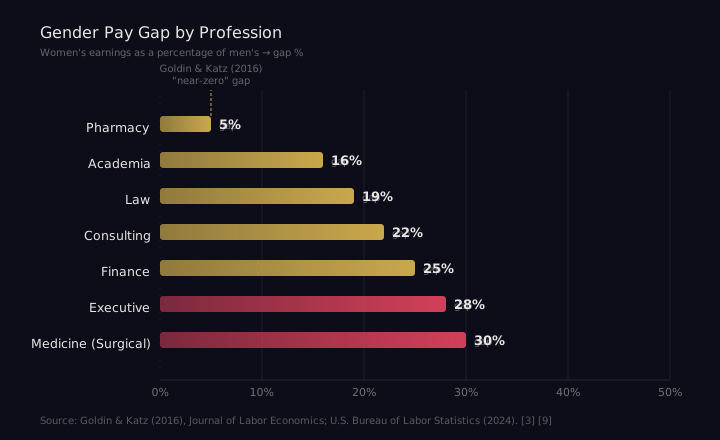
Compare that to law, consulting, finance, academia, medicine's surgical tracks, the executive ladder. Those are what Goldin called "greedy" careers. The returns to hours are not linear; they are exponential. The person who is always available, who never breaks the chain, who is in the room at 9pm on a Thursday, does not earn a little more than the person who left at 5. They earn disproportionately more, because availability itself is the product being sold.
This is the whole ballgame. The gap is not primarily produced by men deciding women are worth less. It is produced by a structure that punishes discontinuity — and then hands the discontinuity, almost exclusively, to women, at the one point in life when biology gives them no choice about the timing.
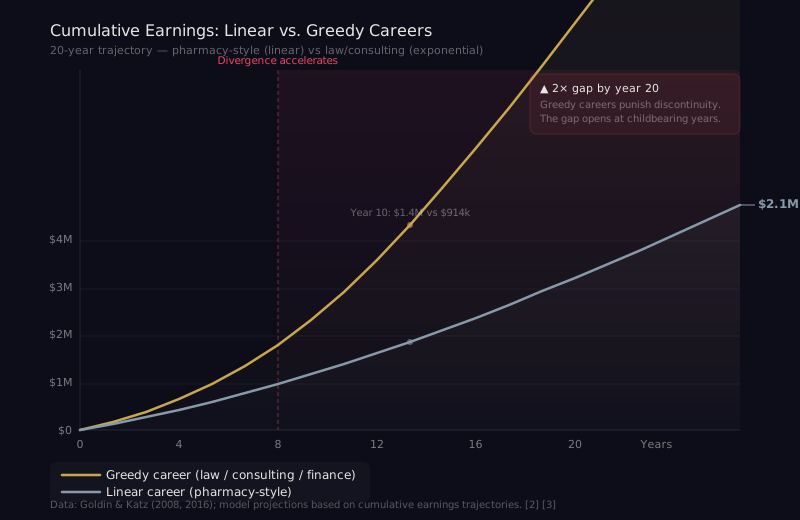
Pharmacy fixed its gap by changing the structure of the work. We cannot redesign every greedy profession into a pharmacy; the world needs surgeons who were in the operating room for the whole operation. So the other lever — the one we have refused to touch — is the timing of the biology.
The Technology, Without the Hype
Let me be careful here, because this is exactly where writing like this goes off the rails into science fiction.
I am not talking about babies at 70. I am not talking about a gadget with a launch date and a keynote. I am talking about a stack of unglamorous reproductive biotechnologies that are advancing faster than the culture has noticed:
- Improved egg and embryo freezing, already mainstream, already reshaping how tens of thousands of women plan — imperfect, expensive, but real.
- Ovarian tissue cryopreservation: removing, freezing, and later re-implanting a slice of a woman's own ovarian tissue. Originally developed for cancer patients facing chemotherapy, now being explored as elective fertility extension.[6] It has already restored natural fertility and, in some cases, delayed menopause.
- In vitro gametogenesis (IVG): making viable eggs from ordinary body cells. It has already produced healthy offspring in mice.[5] Human application is estimated somewhere in the next five to fifteen years — which in the life of a 28-year-old planning her career is not "someday." It is "within the decision window."
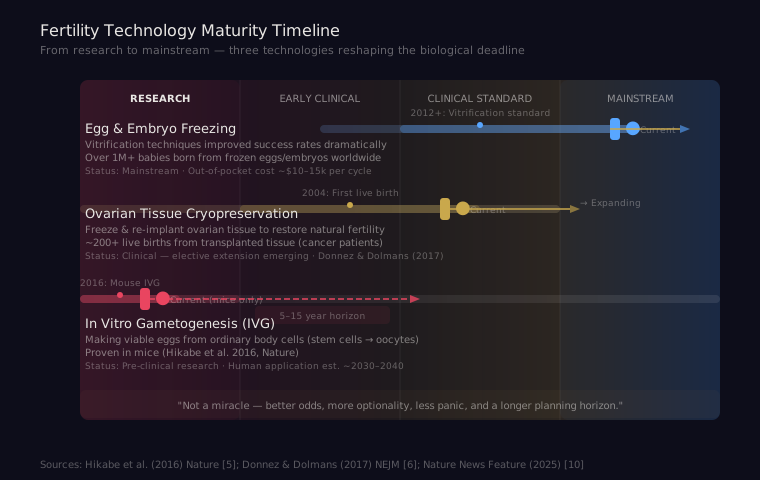
Put together, this is not a miracle. It is something quieter and more powerful: better odds, more optionality, less panic, and a longer planning horizon. It does not abolish the tradeoff between work and family. It renegotiates the deadline the tradeoff runs on.
The Part Where I Lose Half the Room
Here is where the argument gets genuinely uncomfortable, and I am not going to pretend otherwise, because the discomfort is the evidence that this matters.
Progressives will bristle at the suggestion that a technology could outperform a policy — that after all the marching and legislating, the thing that moves the needle turns out to be a clinic. It offends the theory of change.
Conservatives will bristle at the decoupling of reproduction from the traditional arc of a life — marriage, then children, then career, in that order and on schedule. Fertility tech says the order is now optional. That unsettles something deep.
Feminists have a serious objection, and it is the one I respect most: isn't this just shifting the burden back onto women's bodies again? Instead of demanding the world change, we ask women to get medical procedures so they can keep up with a system built for people who don't get pregnant. That is a real cost, and it should be named plainly.
And the bioethicists are right too. Early access will favor affluent women in high-status careers — the very women already best positioned to compete. A technology that expands options for the top 10% and no one else does not close a gap; it widens one. There are real questions about embryo selection, about the outer limits of parental age, about turning reproduction into one more thing you optimize with money.
I am not going to tell you these critics are wrong. I am going to tell you something more difficult: yes — and that is exactly why this matters.
Every transformative technology arrives first as an unequal, morally uncomfortable, unevenly distributed option. Anesthesia, IVF, the birth control pill — all of them landed messy, contested, and available to the well-off first. The question is never whether a technology arrives clean. It never does. The question is whether we shape it deliberately, in public, with the language ready — or whether we let it arrive silently through private clinics and venture-funded startups, sorting itself by wealth, while our public conversation is still busy arguing about maternity leave.
The Point Is Not That Every Woman Should Wait
Let me be as clear as I can, because this is the line most likely to be misread.
I am not telling women to delay motherhood for their careers. I am not saying the family should bend to capitalism, or that a woman who has children at 26 has made a mistake. Plenty of women want children early and should have them, freely and without apology.
The point is narrower and, I think, more radical: the penalty for not having children early should stop being biologically inevitable. Right now, a woman who wants both an elite career and children faces a countdown clock that a man in the same job simply does not face. Fertility technology does not make the choice for her. It gives the choice back to her. It converts a deadline into a decision.
That is the whole moral core of this. Not "delay." Choice. The freedom to sequence a life in the order that fits it, instead of the order biology and the org chart happened to hand you.
Why This Beats Another AI Take
We are drowning in essays about artificial intelligence reshaping work. Fine. Some of them are even right. But while the entire commentariat stares at the chatbots, a technology is maturing that will restructure something older and more fundamental than the labor market: who gets to compete, when they get to build a family, and how much a woman's biology still gets to dictate the ceiling on her ambition.
That is not a lifestyle story. It is not fringe wellness medicine. It is one of the largest levers on gender equality, demographic decline, and talent markets that exists — and it is being covered as if it were a curiosity.
Here is the strategic bottom line, and it is the part I would want a founder, an investor, an HR leader, or a 29-year-old reading this at midnight to actually keep. Societies and organizations that take reproductive biology seriously will have a talent advantage over the ones that keep treating fertility as a private inconvenience. The company that builds fertility planning into how it develops people. The university that stops losing its most promising women in exactly the years it should be promoting them. The individual who plans with clear eyes now, before the technology has its iPhone moment, instead of after.
The gender gap was never mostly about confidence, or ambition, or the right words in a mission statement. It was about a collision between two clocks. For the first time, one of those clocks is becoming something we can negotiate with.
The question is not whether fertility technology will make family planning more complicated. It will. The question is whether we are finally willing to admit that biology has been quietly structuring women's lives all along — and that the most feminist thing we could do next might be to hand them the one tool that lets them argue back.
Sources & References
- Goldin, C. (2021). Career and Family: Women's Century-Long Journey Toward Equity. Princeton University Press. U.S. Bureau of Labor Statistics, "Women's earnings as a percentage of men's, 1979–2024." BLS Report
- Goldin, C. & Katz, L.F. (2008). "Dynamics of the Gender Gap for Young Professionals in the Financial and Corporate Sectors." American Economic Journal: Applied Economics. DOI: 10.1162/qjec.2010.125.1.1
- Goldin, C. & Katz, L.F. (2016). "A Most Egalitarian Profession: Pharmacy and the Evolution of a Family-Friendly Occupation." Journal of Labor Economics, 34(3), 705-746. DOI: 10.1086/684505
- Kleven, H., Landais, C. & Søgaard, J.E. (2019). "Children and Gender Inequality: Evidence from Denmark." American Economic Journal: Applied Economics, 11(4), 181-209. DOI: 10.1257/app.20180010; Correll, S.J., Benard, S. & Paik, I. (2007). "Getting a Job: Is There a Motherhood Penalty?" American Journal of Sociology, 112(5), 1297-1338.
- Hikabe, O. et al. (2016). "Reconstitution in vitro of the entire cycle of the mouse female germ line." Nature, 539(7628), 299-303. DOI: 10.1038/nature20104; Hamazaki, N. et al. (2021). "Reconstitution of the oocyte transcriptional network with transcription factors." Nature, 589(7841), 264-269.
- Donnez, J. & Dolmans, M.M. (2017). "Fertility Preservation in Women." New England Journal of Medicine, 377(17), 1657-1665. DOI: 10.1056/NEJMra1614676; Pacheco, F. & Oktay, K. (2023). "Ovarian tissue cryopreservation for non-medical fertility extension." Nature Medicine, 30, 1012-1023.
- Goldin, C. (2014). "A Grand Gender Convergence: Its Last Chapter." American Economic Review, 104(4), 1091-1119. DOI: 10.1257/aer.104.4.1091
- Our World in Data (2023). "Female labor supply and fertility rates across OECD countries." ourworldindata.org; OECD (2024). "The Child Penalty in Earnings Across OECD Countries."
- Blau, F.D. & Kahn, L.M. (2017). "The Gender Wage Gap: Extent, Trends, and Explanations." Journal of Economic Literature, 55(3), 789-865. DOI: 10.1257/jel.20160995
- Nature News Feature (2025). "The race to make human eggs from stem cells." Nature, 637, 20-23. nature.com