
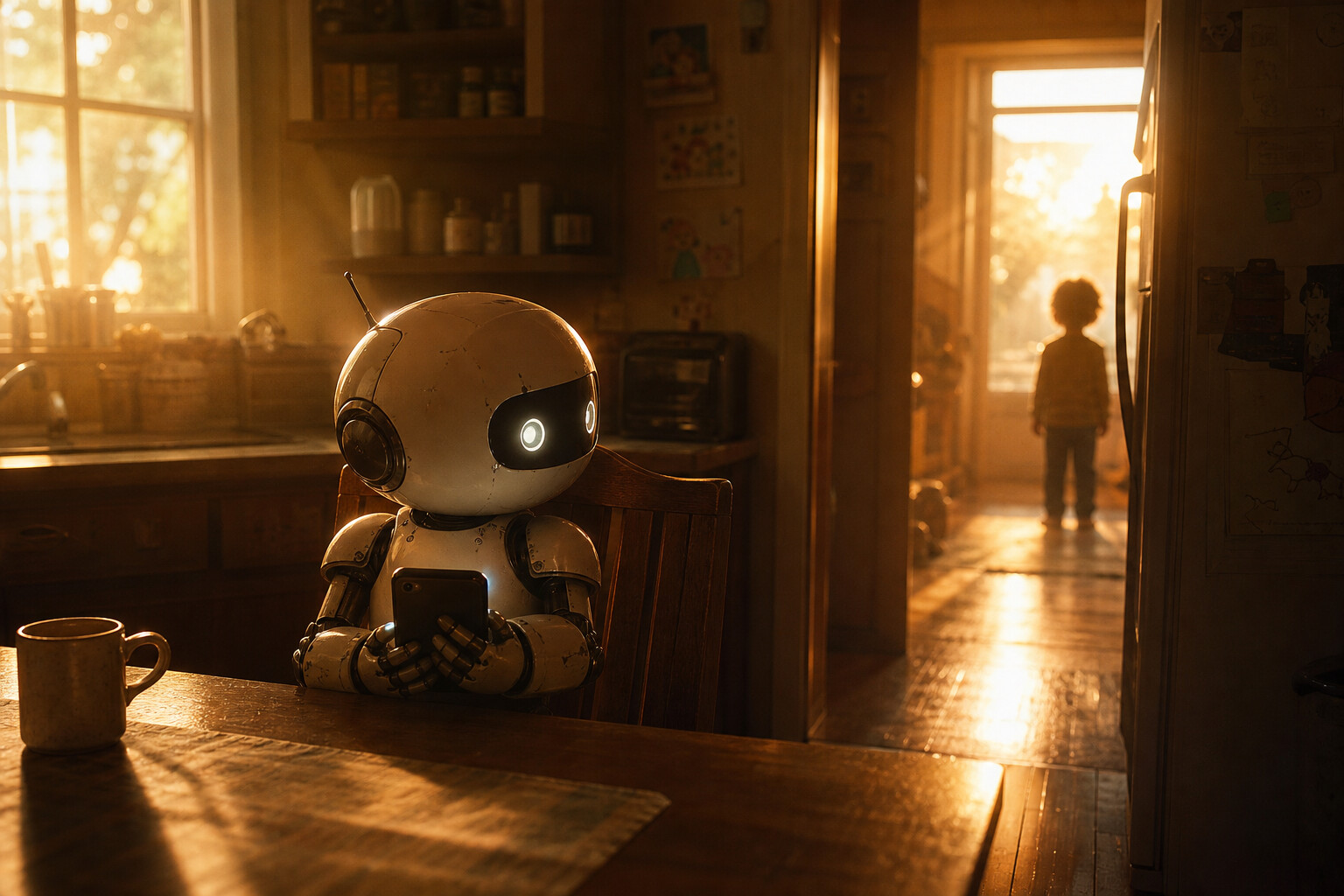
There is a study making the rounds, and it comes with a headline built to detonate in your chest. Parents on their phones, it says, are damaging their children — breeding insecurity, anxiety, avoidance. The paper even opens with a line engineered for maximum guilt: a small girl asking her mother, "Mommy, do you love your phone more than me?"
Read that sentence and you are supposed to feel the floor drop. That is the point. It is not evidence. It is a hook. And I want to argue something that will sound heartless until you follow it through: the panic over "distracted parenting" is not science. It is the oldest guilt in the world wearing a lab coat.
What the Study Actually Found
Let's be precise, because precision is where the panic dies. The paper, published in Frontiers in Psychology in June 2026, surveyed 600 American teenagers aged twelve to seventeen. The researchers built a questionnaire — the Device Attachment Interference Scale — asked kids how they perceived their parents' phone use, then asked those same kids to rate their own attachment security on a second questionnaire. They found that teens who reported feeling ignored also reported feeling more anxious and avoidant.
That is the whole finding. Read it again. It is a correlation between two self-reports, collected from the same teenagers, at the same moment, on the same afternoon. Nobody watched a single parent. Nobody measured a single phone. Nobody followed a single child across time. The entire causal story — phones make children insecure — is smuggled in through a headline the data cannot carry.
To their credit, the authors are careful. Buried in the paper are the words every honest researcher uses and every press release ignores: cross-sectional, associational, limitations. They do not claim causation. The problem is that the moment this leaves the journal, the caveats are stripped like packaging and what reaches the parent is a verdict: you did this.
The Direction of the Arrow
Here is the question the panic never asks. Which way does the arrow point?
The study assumes a tidy line: parent looks at phone → child feels neglected → child becomes insecure. But a teenager who is already anxious and avoidant — for reasons of temperament, genetics, a hard year, a divorce, a friendship that collapsed — will perceive a parent's every glance at a screen as rejection. Insecure kids read neutral events as abandonment. That is what insecurity is.
So the correlation is exactly what you would expect if the causation ran the other way entirely: unhappy kids reporting that their parents feel far away, and reaching for the nearest visible object to explain a feeling that predates it. The phone is not the wound. The phone is what the wound points at.
We Have Been Here Before
If this pattern feels familiar, it should. Every generation invents a device that is destroying its children, and every generation is certain that this time it is real.
The novel was going to rot young women's minds. The radio was going to fracture the family evening. The comic book, per a 1954 bestseller and a US Senate hearing, was manufacturing juvenile delinquents. Television was the "plug-in drug." Rock music, video games, the internet — each arrived with earnest researchers, alarmed clinicians, and a public ready to believe that the thing in the child's hand was the reason the child was unhappy.
They were all wrong in the same specific way. They mistook a symbol of change for its cause. And they all served the same hidden function: they gave anxious adults a simple villain to point at, so that the harder, more expensive, more personal questions could stay unasked.
The Guilt Machine
This is what I mean when I say the panic is old guilt in a lab coat. There is an entire expert economy — clinicians, consultants, authors of the next mindful-family book — whose relevance depends on discovering fresh ways for ordinary parents to be failing. The distracted-parenting scare is a perfect product. It requires no policy, costs the experts nothing, and lands on precisely the people least able to defend themselves: parents who are already tired, already stretched, already certain they are not doing enough.
And notice who gets indicted. Not the parent with a nanny and a four-day week. The one checking a work email at the kitchen table because the job followed them home. The single mother answering a message because the message might be the school, or the landlord, or the second job. The panic dresses up as concern for children and functions as a tax on the harried.
Meanwhile the actual evidence on what children need is boring and well-established, and it is not surveillance-grade attention. Children need secure attention, not constant attention. Decades of attachment research — the real kind, longitudinal, observational — say what matters is whether a child can rely on a caregiver to return, to repair, to show up when it counts. A parent who glances at a phone and then looks back up is not rupturing a bond. They are modeling the ordinary rhythm of a divided adult life, which is the life the child will one day live.
What the Panic Costs
I am not arguing phones are harmless. Doomscrolling at the dinner table is rude, and a parent who is genuinely, chronically absent behind a screen is failing a child — but that parent was failing before the iPhone, and would fail without it. The device did not invent neglect. Neglect is old.
What I am arguing is that the manufactured version of this fear does real damage of its own. A parent convinced that every glance at a screen is a micro-trauma does not become a better parent. They become an anxious one — and anxiety is contagious across a dinner table in a way a text message never was. We have good evidence that parental guilt and hyper-vigilance make family life worse, not better. The panic is not protecting children. It is teaching parents to perform attention instead of giving it.
The Strongest Version of the Other Side
Let me give the other side its best shot, because a position that cannot survive its opponents is not worth holding. The serious argument is not about a single glance. It is about volume. The smartphone is not the radio; it is engineered by some of the most capable behavioral scientists alive to be maximally difficult to put down. A parent in 1975 got bored of the newspaper. A parent in 2026 is losing an unfair fight against a device tuned to win it. If the quantity of divided attention has crossed a threshold no previous distraction reached, then maybe the difference in degree has become a difference in kind.
It is a real argument, and I take it seriously. But it cuts against the study, not for it. If the concern is the engineered pull of the device, then the target is the designers, the incentive structure, the attention economy — not the exhausted mother at the kitchen table. You do not fix a slot machine by shaming the people it was built to capture. And notice that this stronger argument requires evidence the study does not have: actual measurement of how much, how often, and with what effect over time. The panic borrows the credibility of the serious critique while doing none of its work. It wants the moral weight of "engineered addiction" and the cheap target of "bad parents," and it should not get both.
The Take
So here is my position, and I will defend it. Put down the study, not the phone. A single afternoon's questionnaire filled out by 600 teenagers cannot tell you that you are harming your child, and it is a small scandal that it was ever allowed to imply otherwise.
Be present when it counts. Return when your child reaches for you. Repair when you get it wrong. That is the whole science of raising a secure human being, and it survived the novel, the radio, the television, and it will survive the smartphone in your hand.
The question was never "Mommy, do you love your phone more than me?" The question is why we keep building an entire industry out of teaching parents to be afraid of the answer.